
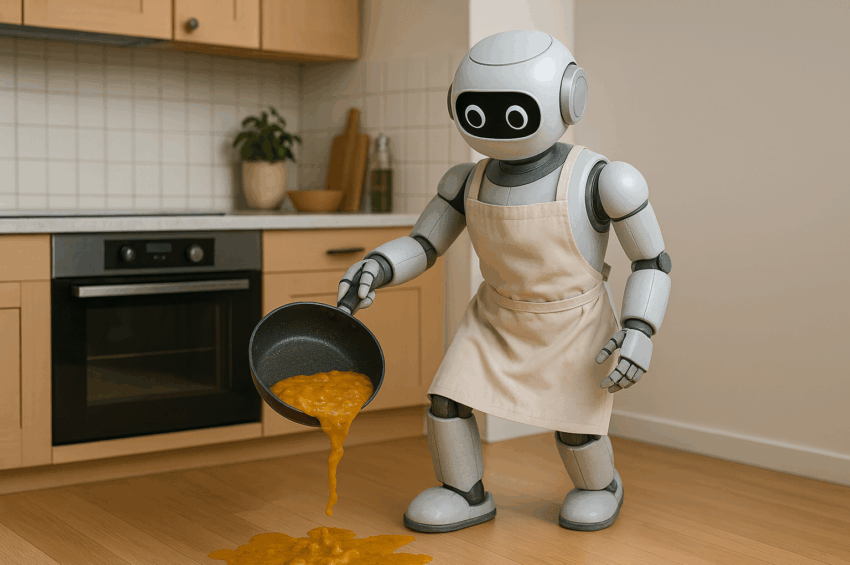
I was crying with laughter the other day. My stepdad Dave (becoming a regular feature in my articles) showed me a clip from “Have I Got News For You” of their segment on humanoids attempting to cook and clean. The hapless robot, frying pan in hand, slid the contents onto the floor and started slipping and sliding, its human owner rushing in to rescue it and skidding across the curry-drenched floor himself. Pure comedy gold, and an indicator that effective robot housekeepers are still very much in the experimental phase – I was quite literally wiping away tears at the sketch.
Yet this is evidence that tech companies are investing heavily in this particular area of R&D. The interest in this technology indicates that there are gaps in humanity that we are looking to fill with subservient, compliant replacements for real human connections, which is worrying in itself. These mechanical slaves would not express needs of their own, their whole existence would be to serve their owners, and while it is a dream of many a busy professional to have their domestic chores done for them, the reality spells out a greater detachment from the essence of humanity – community and company.
There is a concerning leaning towards solving the labour crisis in the care industry with robots. My Mum, almost 71 and severely disabled from MS, lives with me. She has carers come in to do her meals and personal care, for everything else, she has me. Curious to know what her take on this was, I posed the question “If the care company told you they were sending you a robot to do everything, what would you say?”. She just rolled her eyes, snorted and said “Bloody hope not”. That response tells far more than any research paper ever could – the real, human need for CARE, not service, far outweighs any benefits of convenience and low maintenance profit. It is becoming a question of ethics – the use of robots to replace humans in caring for the most vulnerable in our society is simply untenable. Groups of people already at risk of isolation would lose the final elements of contact with other humans that they had – the regular visits from their carers and support staff.
This is not just abstract theory. A conference paper from Yang & Zhou (2025) provides a systematic review of studies focusing on assistive robotic care, worryingly the tasks set to these robots includes “human-robot interaction” and “mental health support”. These are tasks that should never be delegated to robots and artificial intelligence – no robot can understand the complexity and nuances of the human mind, or empathise with loneliness and despair. Housework is one issue, but the emergence of real scientific research into the use of robots for these deeply human tasks is indicative of the trajectory humanity is going on, and it is not a pleasant prospect.
The quest for a capable robot cook having dinner warmed and ready for when you get home from work is one that will fascinate scientists and engineers for years to come. Yet the billions invested into creating robots to provide mental health support would be better directed towards improving the pay, status and conditions of those in the caring professions. The global population is projected to peak around 2084, then decline (UN Population Division, 2024), so the crisis in the care industry will reach its climax as my generation of forty somethings hit old age. A human approach to solving this is needed, as I for one do not want a walking, talking version of ChatGPT as my only source of company. We owe our elderly far more than being fobbed off with robots, and it is about time regulators and governments stepped in to address the vast resources being directed towards this solution. People need people, period.
Kate Stapleton