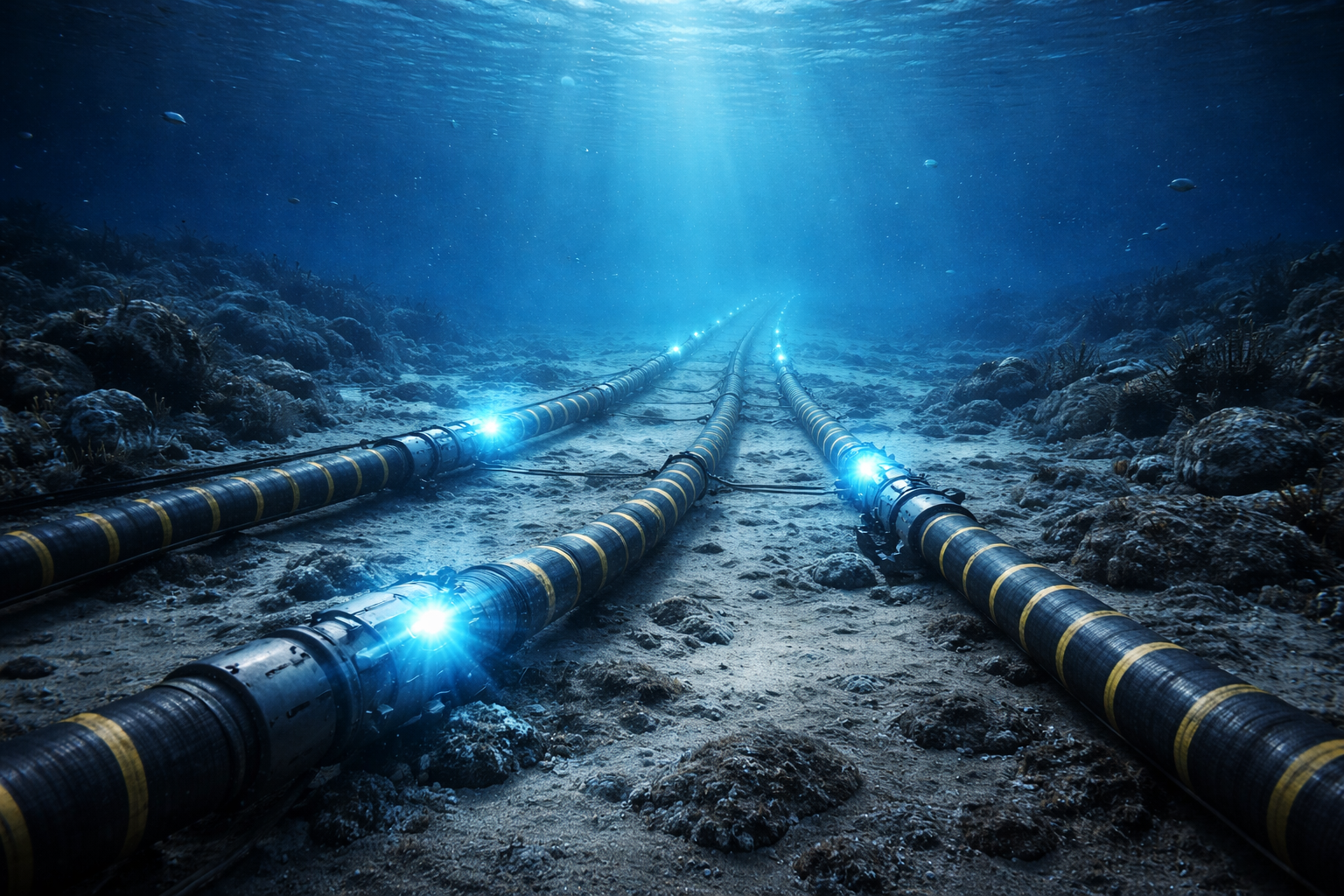
I read a really good article a few days ago about the collapse of an old cable system. It made me smile for some reason because it described the retrieval of thousands of kilometres of spent cable from the ocean floor in dull, mechanical terms. There was no grand relaunch or optimisation phase 2. It was just a slow unwind of something that had once been important.
The cable I am referring to is TAT8 (Transatlantic Telephony Cable 8), laid in 1988. It was the first transatlantic fibreoptic cable. This is not the same as the first cable to cross the Atlantic; Victorians managed to achieve this in 1858 with a telegraph cable that briefly worked before failing in a dramatic fashion. I assume one was not amused at the time.
Later cables also crossed the Atlantic, including pre-World War II copper telephone cables such as TAT1. Many of these early cables were not retrieved and instead remain scattered across the floors of the oceans. Most of these abandoned cables have simply decayed because, unlike with the industrial revolution on land, once abandoned, we never returned to remove the remnants. Instead, we built a new facility or cable and left the old paraphernalia to rust.
TAT8 was different from its predecessors. It didn’t just rapidly increase the amount of electricity crossing the ocean; it also replaced that electricity with light. As a result, information began to traverse the ocean as pulses of light rather than electrical signals, dramatically increasing capacity and reliability, and the first pulses of internet traffic joined conversations in financial trading rooms and the correspondence of businesspeople the world over.
But it filled far faster than expected. Not necessarily because anyone had made a mistake or because capacities had been under allocated. Because, as everyone seems to forget, the more you build, the more of it will be consumed just as quickly. It’s not being hauled up for copper salvage. TAT-8 is a fibre optic system, not a copper telegraph cable.
Nowadays, we are focused on satellites and the cloud, but undersea cables are where it’s at, so to speak. Less than 4% of data travels by satellite; the rest passes through subsea cables. We imagine information zipping through the ether, but in reality, most of it travels down a physical pipe buried in the ocean bed. Physically vulnerable and difficult to repair once deployed, they’re becoming ever more critical to the global economy.
Are they just infrastructure that can be left to stand still? What is the next step for fibreoptic cable? It is not simply more cables, thicker cables, or a faster repeater tied ever so slightly closer together in a line. At some point, the thinking starts to get a little dated.
Eventually, the nature of fibreoptic cable must give way to something far more sophisticated. You can see that direction from afar: monitoring subsystems in real time to predict failures before they happen; autonomous repair systems; or short-lag subsea robotics that can physically go in to repair a fault before things go bad. Monitoring systems that alert you the instant a fibre becomes unhealthy before it ever affects traffic, rather than waiting for 24/7 on call teams to notice elevated error rates over the course of weeks.
At these scales, fibre-optic cables begin to behave like living organisms. Traffic reroutes at the speed of light before even the transport manager realises something is amiss.
Currently, submarine internet cables are laid out as fixed cables along the sea floor, following the shortest distance between two points. However, this fixed geometry is not optimum. If there is a fault with the cable, it can be extremely difficult and costly to repair. As demand grows faster than capacity, multiple fibre pairs are required, which in turn increases the physical size of the cable.
A future solution would be to lay out cables as part of an active grid, through a series of intelligent switches or repeaters that form a submarine telecommunications network. Information would then travel in multiple directions between these relay points, allowing it to change course quickly if there is a problem and to increase capacity as required. In essence, the submarine backbone would become an intelligent and adaptive network.
And energy. Because in addition to moving large amounts of data across the subsea cables connecting countries, you’re also supplying power along the cable to keep repeaters and amplification systems running. Compute nodes could be located offshore, and edge processing performed as you go, reducing the load required to send information back to a centralised hub and spoke datacentre architecture.
The subsea cable is no longer merely a pipe for moving information between locations; it is now a critical component of distributed computation.
But even if we didn’t want to go all the way to teleportation, we have quantum communication, which, unlike fibreoptic communication, can guarantee the security of what is being communicated and make it difficult for people to intercept messages. Quantum communication isn’t about making things go faster; in fact, it isn’t really designed for long distance transmission (so far, at least), although it could potentially be using fibre or satellites. It is currently still early days and pretty much the sole domain of scientists and huge corporations, but it is a technology with clear strategic benefits.
The questions then are about how to roll it out, and when it matures, what will happen to our existing telecoms infrastructure: will someone control a secure superlayer, and if so, who?
But there’s a more pressing issue at play here: who owns the cables? Early undersea cables were created by consortiums of multiple companies. These still exist today, but the largest technology companies are increasingly opting to build their own subsea networks, effectively controlling and owning the infrastructure that enables global communication. It’s efficient, perhaps, but not without consequence.
Now, let’s think about TAT8 for a moment. It’s the first of the large submarine cables, but the pattern of design and operation that TAT8 represents is still with us today. We design, we miscalculate, we overload, and we replace.
The Victorians would have left the miles of subsea cable simply to rot on the seabed. We are slightly more civilised and recover the cable for responsible recycling. The question will be what we are putting in place now that future engineers will have to rip out to upgrade our network backbone, and whether, by then, we will still control the system that we will have created.
By Peter Zanatta